The Future of Location-Based Entertainment is Being Built Today in Canada


Location-based Entertainment is Evolving.
Canadian consumers have more entertainment available at home than at any point in history. Yet businesses built around physical experiences continue to attract significant investment, occupy commercial spaces and find new ways to bring people together.
There is a simple reason this matters: technology has made entertainment more accessible, but it hasn’t replaced our desire for shared experiences.
People still want reasons to get together. Families want activities they can safely enjoy together. Friends want to compete, celebrate and discover new things. Companies want experiences that bring teams together outside the workplace.
At the same time, another evolution is taking place behind the scenes.
The conversation around location-based entertainment is expanding beyond the attraction itself. Operators and industry specialists are paying increasing attention to staffing, throughput, reliability, repeat visitation, space utilization, operating costs and the systems required to deliver a successful experience consistently.[1]
That shift matters to anyone evaluating the industry as a business opportunity.
As an industry matures, the question begins to change from:
“What can this technology do?”
to:
“How intelligently can we build a business around it?”
For entrepreneurs, investors and market developers looking beyond a single attraction toward something capable of growing, that may be one of the most important developments to understand and take part into.
Entertainment Is Becoming More Experiential
Digital entertainment has made staying home remarkably easy.
Streaming, gaming, social media and increasingly sophisticated home technology provide an almost unlimited supply of entertainment without requiring consumers to go anywhere.
Yet physical experiences continue to play a major role in commercial real estate.
In 2025, JLL reported that dining, entertainment, fitness and wellness represented more than half of announced store openings in Canada during the first quarter and more than 40% of U.S. announcements over the preceding year.[2]
The broader message is significant: experiences continue to give consumers reasons to visit physical places.
That doesn’t mean every experiential concept succeeds. No business category works that way.
It demonstrates something more fundamental:
Commercial space remains valuable when they provide an experience worth leaving home for.

Why Social Experiences Still Matter
For location-based entertainment, one of the strongest reasons to leave home is also one of the oldest:
other people.
People don’t celebrate a birthday together simply because they need entertainment.
Friends don’t organize a night out because they lack something to watch at home.
Families don’t look for activities together because they have run out of screens.
They are looking for something shared.
Location-based entertainment can create those moments through:
- playing together
- competing together
- moving and participating physically
- celebrating milestones
- discovering something new
- sharing a safe experience with friends, family and colleagues
The activity matters, but so do the reactions around it, the competition, the laughter, the conversation and the memories people take home afterward.
That distinction is important. Its advantage is giving people something fundamentally different: a reason to experience entertainment together.

Industry Insight
Location-based entertainment is becoming easier to understand as a business.
People want experiences they can share.
Technology continues to improve.
And years of industry experience have taught operators more about how to deliver those experiences consistently.
The result is an important shift.
Highly immersive entertainment experiences no longer need to mean a complicated business.
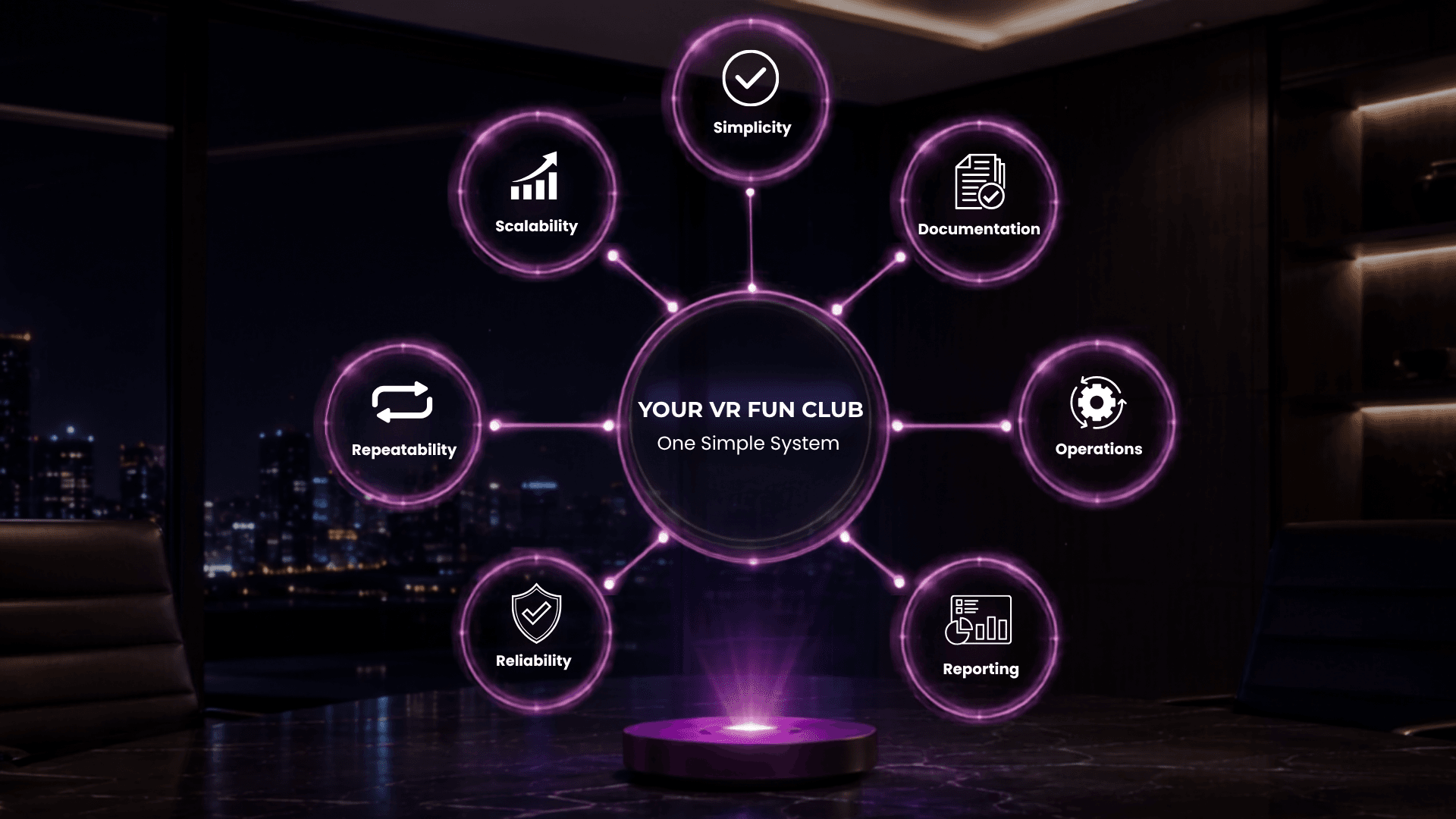
The opportunity is increasingly about bringing the right pieces together so they work as one simple, repeatable and reliable operation.
What This Means for a Prospective Distributor
As a prospective distributor, that matters.
Because your goal is to have an operation that is simple enough to understand, organized enough to manage easily and discipined enough to support growth.
And that’s where our own journey began.
After years of studying the evolution of location-based entertainment, we kept coming back to one question:
How simple could this business become if it were designed around everything the industry has learned?
That question helped shape the way Your VR Fun Club has approached the opportunity.
Industry Insight focuses on the forces shaping location-based entertainment and the business principles influencing its evolution.
At Your VR Fun Club, those observations continue to shape how we think about growth, consistency and development.
For qualified entrepreneurs interested in exploring selected Canadian markets, the details of our operating model are discussed privately as part of the evaluation process.
Explore Regional Opportunity →
Sources:
[1] IAAPA — 2025 Entertainment Center Benchmark Series
Global entertainment-center benchmark research based on 2024 operator data, covering attractions, admissions, staffing, guest behavior, revenue generation and expense management.
[2] JLL Research — Experiential Retail / Consumer Experience Research
Commercial real-estate and consumer research examining experiential uses of physical retail and consumer participation in out-of-home experiences.